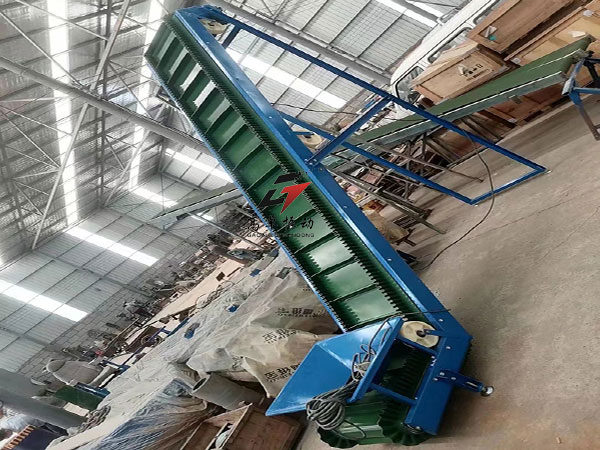
The steep inclined belt conveyor mainly consists of a head drive unit, tail tensioning device and endless conveyor belt. The belt acts as both traction and load-bearing component, wrapping around the drive pulley at the head end and bend pulley at the tail end. The tail tensioning device maintains proper belt tension, while idler rollers support the belt along its length to form a closed circulating loop. When the drive unit rotates the drive pulley, friction between the pulley and belt drives the belt forward. Materials are fed onto the belt through the loading chute and transported to the head discharge unit for unloading.
Working Principle:
The steep inclined belt conveyor is primarily composed of a head drive assembly, tail tensioning system and conveying belt. The endless belt serves as both the traction and load-bearing element, looped around the drive pulley and bend pulley mounted on both ends od the frame. The tail tensioning device keeps the belt properly tensioned, and idlers support the belt along its full length to form a closed circulation circuit. As the drive unit rotates the drive pulley, frictional force between the pulley and belt propels the belt to run continuously. Materials are loaded onto thebelt to the head discharge mechanism for unloading.
Structure:
The steep inclined belt conveyor comprises a tail tensioning device, tail belt hold-down unit, middle support frame, idler assenbly, sidewall conveyor belt, head drive unit, return belt cleaner, belt tracking device and discharge chute.
1. The conveyor adopts a corrugated sidewall belt that performs both traction and load-bearing functions. Corrugated sidewalls, cross cleats and the base belt form pocket-shaped containers for materials, enabling conveying at incline angles up to 90°.
2. The tail frame assembly includes a belt hold-down unit, bend pulley, feed chute, tail frame, screw tensioning device and impact idelers. The hold-down unit stabilizes belt operation and prevents misalignment. The feed chute ensures materials fall onto the belt center. Impact idlers reduce material impact on the belt to extend service life. The screw tensioning device maintains required belt tension to prevent slippage an the drive pulley. The tail frame supports the entire tail assembly.
3. Idler rollers support the conveyor belt and its load to ensure stable operation. Troughed forward-tilt upper idlers are spaced at 1m intervals, and flat lower idlers at 1.5m intervals effevtively prevent belt misalignment on the return side. Idler spacing on convex arc sections is determined by calculation. To prevent belt misalignment, one set of troughed and flat self-aligning idlers is installed every 10 sets of standard upper and lower idles. Rubber impact idlers are arranged at the loading point with 500mm spacing.
4. The return belt cleaner removes adhering materials from the non-carrying side of the belt to prevent material buildup around the tail pulley. It is typically welded to the intermediate frame in front of the pulley during on-site installation, with its scraper blade in contact with the return strand of the belt.
5. The spring-loaded belt cleaner removes adhering materials from the carrying surface of the belt, preventing environmental contamination and belt misalignment. It is mounted on the frame below the discharge pulley furing installation.
Kry Features:
1. Equipped with corrugated sidewall and cross cleat belt, supporting incline angles up to 90°.
2. Simple structure with major components compatible with general belt conveyors, ensuring convenient operation and maintenance.
3. Flexible connection design. Horizontal conveying sections of any length can ve added at both head and tail ends for easy integration with other equipment.
4. Large conveying capacity. The corrugated sidewall design increases the loading cross-section, delivering higher capacity than general belt conveyors at the same incline angle.
5. Stable and reliable operation with reliability comparable to general belt conveyors, plus low noise emission. Noise is negligible as the belt runs on idler rollers.
6. Low energy consumption. Without digging resistance during loading and internal/external frictional resistance during operation, total installed power is significantly lower than other conveying equipment with the same capacity.
Applications:
-
Fine Chemical Industry: Pigments, dyes, coatings, carbon blacks, titanium dioxide, iron oxide, ceramic powder, heavy carbonate, bentonite, molecular sieves, kaolin, silica powder, activated carbon and more.
-
Agricultural Chemical & Minerals: Urea, ammonium chloride, ammonium bicarbonate, soda ash powder, solid pesticides, tungsten powder, pesticide additives, copper concentrate powder, coal powder, phosphate rock powder, alumina powder and more.
-
Building Materials: Cement, clay, yellow sand, quartz sand, clay powder, silica stone, linestone powder, dolomite powder, wood dust, glass fiber, silicon fioxide, talcum powder and more.
-
Food Industry: Flour, starch, grains, milk powder, food additives and more.
If you need a space-saving conveying solution for steep incline or vertical bulk material transfer, Gaozhuo's steep inclined sidewall belt conveyors deliver reliable performance with low operating costs. We offer custom configurations including belt material options, angle adjustments and enclosed designs to match your specific material and layout requirements and receive a free, no-obligation quotation.
Email: tujingli@gzvibratingscreen.com丨Tel: +86 13403738206