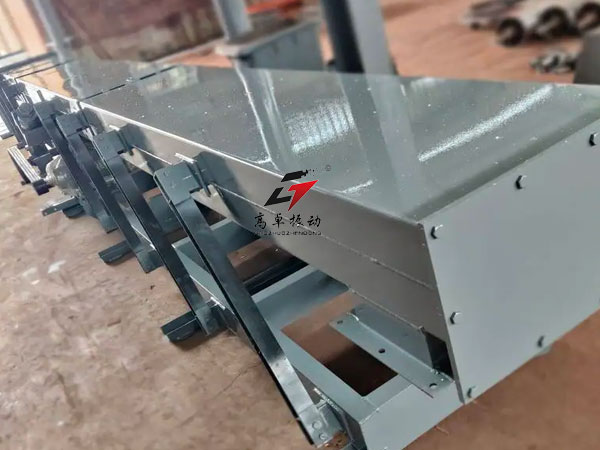
The elastic connecting rod vibrating conveyor, also known as swing rod vibrating conveyor, is an important type of vibrating conveyor. It uses the rotation of an eccentric shaft (crank) to drive the connecting rod and main vibration springs, which in turn move the vibrating trough in linear reciprocating motion to achieve continuous material conveying.
Working Principle:
The electric motor drives the eccentric shaft to rotate through V-belts, causing the driving connecting rod to perform reciprocating motion. The excitation force is transmitted to the trough through the main vibration springs, making the trough vibrate in an approximately linear direction as specified by the guide rods. Materials are periodically thrown or slid under the action of intertia, thus realizing directional conveying.
Near-Resonance Operation: The system operates in the near-resonance zone by adjusting the stiffness of the main vibration springs, resulting in high energy utilization efficiency and stable operation.
Single-Mass and Double-Mass Configurations: They are available in two configurations: single-mass and double-mass, based on the number of vibrating masses. They double-mass structure balances inertial forces and significantly reduxes dynamic loads on the foundation.
Key Features:
1. Low Frequency, Large Amplitude: Particularly suitable for long-distance (up to 50m) and large-capacity (up to 300t/h) material conveying scenarios.
2. Strong Adaptability: It has no strict requirements on material particle size and moisture content. Can convey block, granular and powdery materials, but not suitable for viscous materials.
3. Sealing and High-Temperature Resistance: Enclosed trough design allows conveying of high-temperature, flammable, explosive, toxic or dusty materials. Can handle materials up to 300°C with air cooling and below 500°C with circulating water cooling.
4. Simple Structure, Low Energy Consumption: It has fewer moving parts, resulting in easy maintenance and low power consumption.
Structural Components
The elastic connecting rod vibrating conveyor mainly consists of the following core components:
-
Power and Transmission Section: Electric motor, V-belts, pulleys. eccentric shaft (crank)
-
Connecting Rod Drive Section: Driving connecting rod, driving rubber springs (compression rubber springs)
-
Vibration Main Body Section: Trough (for carrying Materials), frame (base frame)
-
Elastic Elements: Main vibration springs (to keep the system operating in near-resonance state), isolation springs (to support the equipment and reduce dynamic loads transmitted to the foundation)
-
Guide Components: Guide rods (to adjust the movement direction of the trough, usually installed at an inclination)
Applications:
-
Foundry Industry: Especially suitable for conveying hot used sand, casting or small batch parts in the shakeout section of foundry workshops. Provides more convenient transition for shakeout xonveying of flaskless molding castings.
-
Mining and Metallurgy: Used for conveying various bulk mineral materials such as ores and coal.
-
Chemical and Building Materials: With its excellent sealing performance, it can convey dusty, toxic or high-temperature materials. It can convey dusty, toxic or high-temperature materials. It can also complete processes such as drying and cooling during conveying.
If you are looking for a reliable and energy-efficient conveying solution for your bulk material handling needs, especially for high-temperature or dusty materials, Gaozhuo's elastic connecting rod vibrating conveyors are your optimal choice. We offer both single-mass configurations with customized trough designs to meet your specific process requirements. Contact us today to discuss your project details and receive a detailed, no-obligation quotation.
Email: tujingli@gzvibratingscreen.com丨Tel: +86 - 13403738206